Debt Snowball Worksheet (Free Printable + Calculator)
Last updated: November 28, 2026 · By The Barefoot Budgeter Team · Educational content, not financial advice.
A debt snowball worksheet is a one-page list of every debt you owe, sorted from the smallest balance to the largest, with space to track each payment. You pay the minimum on everything, throw every extra dollar at the smallest debt, and when it’s gone you roll its payment into the next one. The payment grows like a snowball rolling downhill.
Below: the exact steps, a worked example comparing the snowball with the avalanche method (with real interest math), a calculator for your own debts and a free printable worksheet and payoff tracker, no email needed.
Jump to the free debt snowball worksheet ↓
In this guide
What is the debt snowball method?
The debt snowball is a debt payoff plan that orders your debts by balance, smallest first, and ignores interest rates when choosing which debt to attack. Its cousin, the debt avalanche, orders debts by interest rate, highest first. Both methods use the same trick: you keep paying the same total amount every month, so every paid-off debt frees up money for the next one.
Interest is why the order matters. The Federal Reserve’s G.19 consumer credit release (November 6, 2026) put the average interest rate on credit card plans at 21.19% for all accounts and 22.36% for accounts that were charged interest in the third quarter of 2026. At those rates, a balance you only pay the minimum on can take years to clear.
So why would anyone pay the small debt first instead of the expensive one? Behavior. In a study of debt settlement clients published in the Journal of Marketing Research, Kellogg School researchers found that closing debt accounts predicted successful debt elimination, regardless of the dollar size of the accounts closed. Quick wins keep people going.
How to use a debt snowball worksheet
1. List every debt
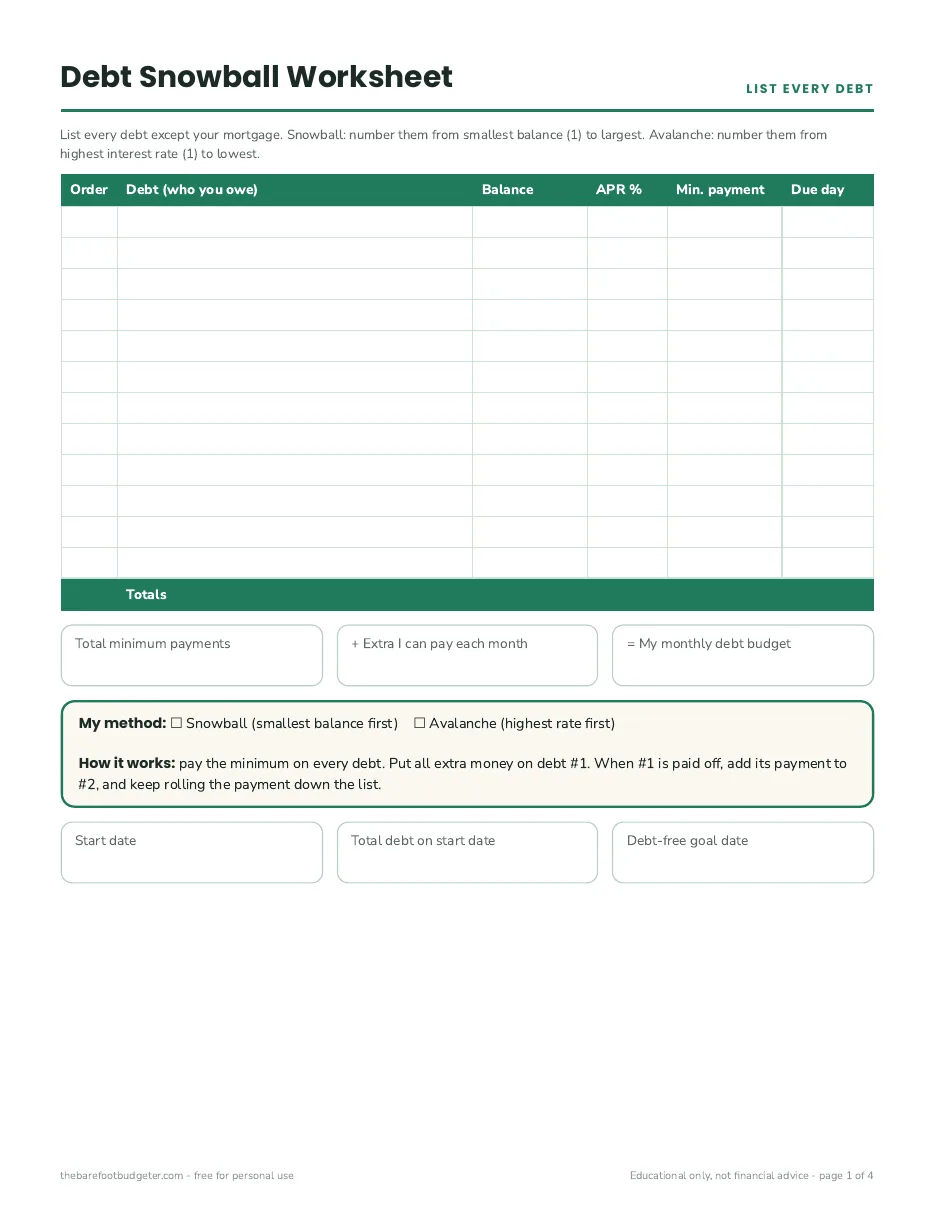
Write down every debt except your mortgage: credit cards, store cards, medical bills, personal loans, car loans, student loans and buy-now-pay-later plans. For each one note the balance, interest rate (APR), minimum payment and due date. Your latest statements or online accounts have all four.
2. Sort by balance, smallest first
Number the debts from the smallest balance (#1) to the largest. If two balances are close, put the one with the higher interest rate first.
3. Find your extra amount
Add up the minimum payments. Then look at your budget and decide how much extra you can pay every month, even $50. Minimums plus extra is your monthly debt budget, and it stays the same until you’re debt-free. If you budget by paycheck, our paycheck budget guide shows how to fit debt payments around your pay dates.
4. Pay minimums on everything, extra on debt #1
Set up minimum payments on every debt so nothing goes late, then send the extra to debt #1.
5. Roll the payment
When debt #1 is paid off, take its whole payment (minimum plus extra) and add it to debt #2’s minimum. When #2 is gone, roll everything into #3. Your monthly debt budget never changes; it just gets concentrated on fewer debts.
6. Track and celebrate
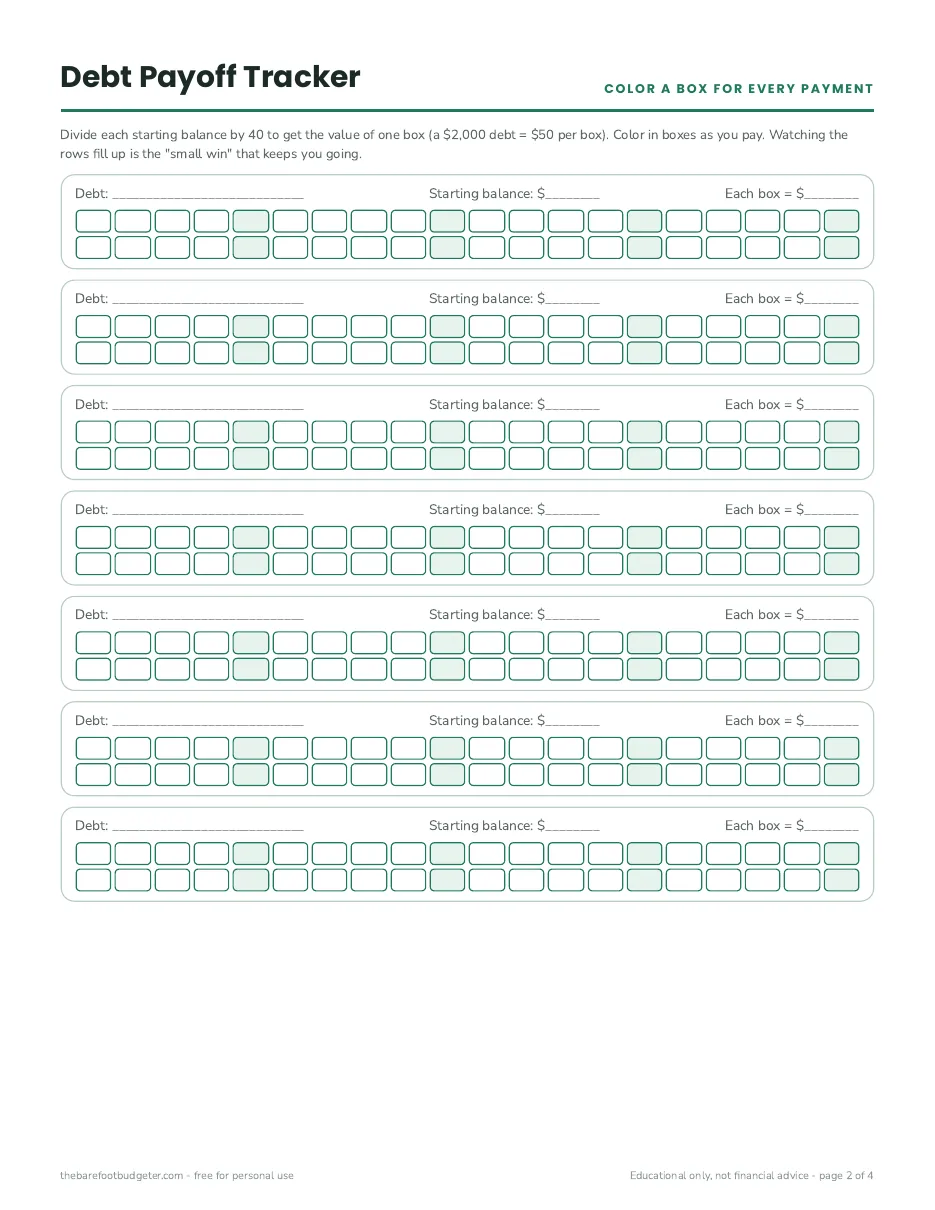
Color in a box on the payoff tracker for every payment and cross off each debt you close. Seeing progress is the whole point of the snowball.
- All debts listed with balance, APR, minimum and due date
- Debts numbered smallest to largest
- Monthly debt budget decided (minimums + extra)
- Minimums on autopay or calendar reminders
- Extra payment going to debt #1
- Payoff tracker on the fridge
Example: snowball vs avalanche with real numbers
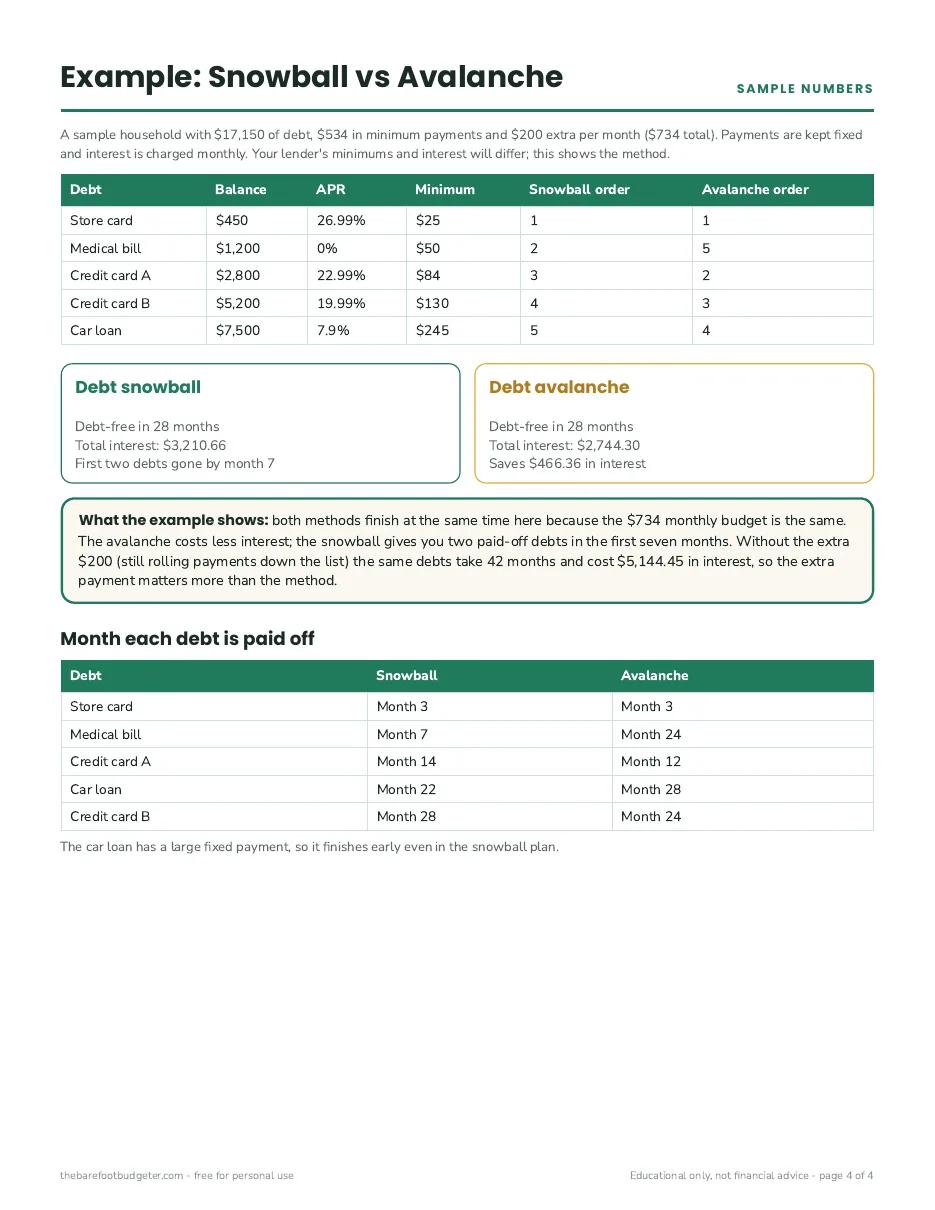
Here is a sample household with $17,150 of debt, $534 a month in minimum payments and $200 extra each month, for a fixed $734 monthly debt budget. We simulated both methods month by month with interest charged monthly and payments held fixed. The figures are for illustration; real minimums usually shrink as balances fall.
| Debt | Balance | APR | Minimum | Snowball order | Avalanche order |
|---|---|---|---|---|---|
| Store card | $450 | 26.99% | $25 | 1 | 1 |
| Medical bill | $1,200 | 0% | $50 | 2 | 5 |
| Credit card A | $2,800 | 22.99% | $84 | 3 | 2 |
| Credit card B | $5,200 | 19.99% | $130 | 4 | 3 |
| Car loan | $7,500 | 7.9% | $245 | 5 | 4 |
| Result | Debt snowball | Debt avalanche |
|---|---|---|
| Debt-free in | 28 months | 28 months |
| Total interest paid | $3,210.66 | $2,744.30 |
| Debts paid off by month 7 | 2 | 1 |
| Interest difference | $466.36 less |
Two things stand out. First, the avalanche saved $466.36 in interest, because it attacked the 22.99% card before the 0% medical bill. Second, the snowball closed two accounts in the first seven months, which is the kind of early win the research links to sticking with a plan. And the biggest lever wasn’t the method at all: with no extra $200 (still rolling payments down the list), the same debts took 42 months and $5,144.45 in interest.
Debt snowball calculator
Enter up to five debts and your extra monthly payment. The calculator runs both methods with your numbers and shows the payoff order, months to debt-free and total interest.
| Debt | Balance ($) | APR (%) | Minimum ($) |
|---|---|---|---|
Estimates only. Real minimum payments, fees and interest calculations vary by lender.
Snowball or avalanche: which should you choose?
The avalanche always costs the same or less interest, so if you are confident you’ll stick with the plan, it’s the mathematically better choice. The snowball costs a bit more but gives faster wins, which matters if you’ve tried and quit before.
| Choose the snowball if… | Choose the avalanche if… |
|---|---|
| You have several small debts you could clear within months | Your highest-rate debt is also one of your biggest |
| You need visible progress to stay motivated | You’re motivated by saving the most money |
| Your interest rates are fairly similar | The gap between your rates is large (e.g. 25% vs 5%) |
A middle path works too: start with one or two quick snowball wins, then switch to the avalanche. Research by Amar and colleagues found that people naturally tend to pay off small debts first even when larger debts carry higher rates, and that focusing attention on the interest each debt accumulated helped participants reduce their overall debt more quickly. Writing the interest rate on your worksheet next to every debt is an easy way to keep that cost in view.
Tips to make your snowball faster
- Find a bigger extra amount: a no-spend month or a lower grocery budget can add $100 or more.
- Use windfalls: tax refunds, bonuses and extra paychecks go straight to debt #1.
- Stop adding new debt: pause card use while you pay down, or the snowball melts.
- Keep a small emergency fund: even a few hundred dollars stops one surprise bill from going back on a card. See our saving money guides.
- Ask for a lower rate: a call to your card issuer costs nothing, and a lower APR speeds up either method.
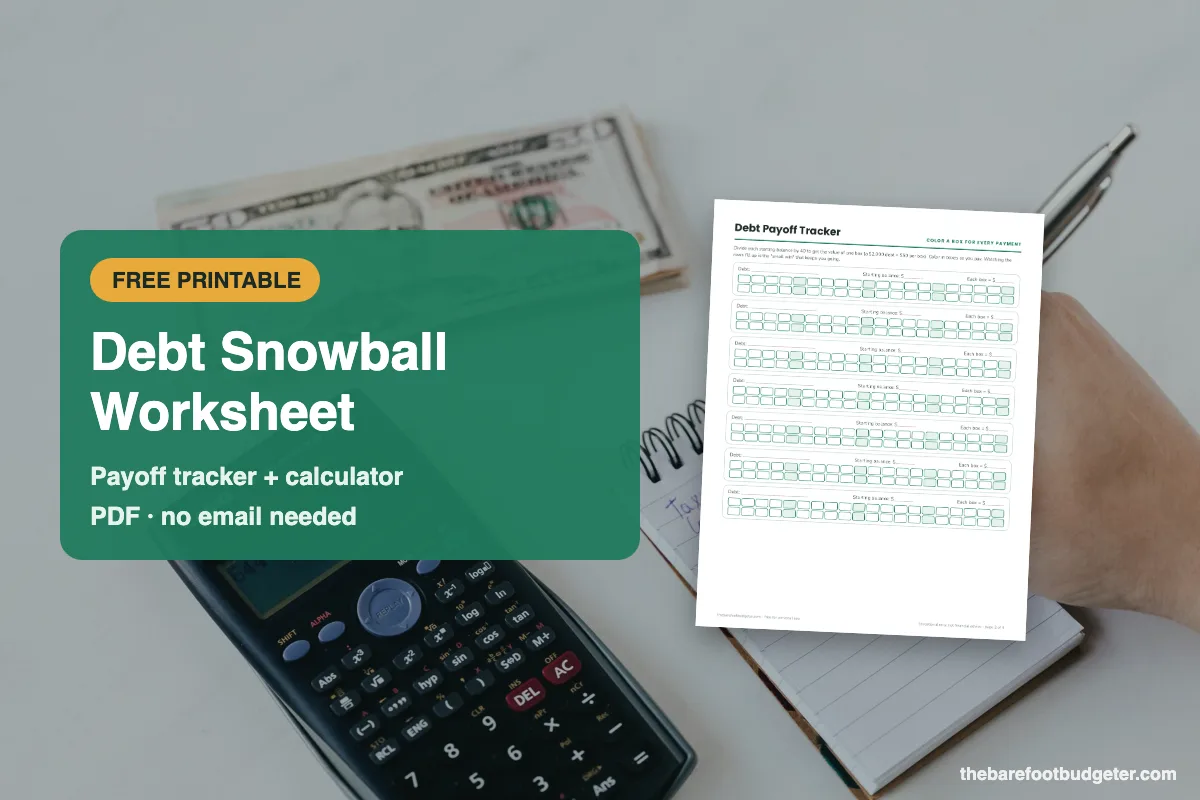
Download your free debt snowball worksheet
- Debt list worksheet and monthly payment log
- Color-in payoff tracker for 7 debts
- Snowball vs avalanche example
FAQ
How does the debt snowball method work?
List your debts from smallest balance to largest, pay the minimum on all of them and put every extra dollar on the smallest one. When it’s paid off, add its payment to the next debt, and keep rolling the payment down the list until everything is paid.
Is the debt snowball or avalanche better?
The avalanche (highest interest rate first) costs the least interest. The snowball (smallest balance first) usually costs a little more but delivers quicker wins, which research links to sticking with debt repayment. In our example the avalanche saved $466 over 28 months.
Should I include my car loan and student loans?
Yes, include every debt except your mortgage. Large loans with low rates will naturally sit at the end of the snowball list.
How much extra should I pay each month?
Any amount helps, because the extra is what speeds the plan up. In our example, adding $200 a month cut the payoff time from 42 to 28 months.
What if I can’t afford more than the minimums?
Start by listing your debts and tracking payments anyway, then look for small savings in your budget. If you are behind on bills, the CFPB and nonprofit credit counseling agencies offer free guidance.
Is the debt snowball worksheet free?
Yes. It’s a 4-page PDF in US Letter size, free for personal use, with no email required.
This guide is for general education and is not financial advice. See our disclosure and how we research.