How to Budget by Paycheck (Free Paycheck Budget Printable)
Last updated: November 28, 2026 · By The Barefoot Budgeter Team · Educational content, not financial advice.
To budget by paycheck, you plan each paycheck on its own: list the bills due before your next payday, set aside savings, give the rest a spending job, and stop when every dollar is assigned. Instead of one big monthly budget, you make a small plan every time you get paid, so rent, car payments and groceries are always covered by the paycheck that arrives before they are due.
Below you’ll find the exact steps, a filled-in example with real numbers, a calculator that shows which months bring an extra paycheck, and a free printable paycheck budget template you can download without an email.
Jump to the free paycheck budget PDF ↓
In this guide
- What budgeting by paycheck means
- Why it works better than a monthly budget
- How to budget by paycheck in 6 steps
- A worked example: two paychecks of $1,850
- Paycheck calendar calculator
- What to do with a third (or fifth) paycheck
- Weekly, biweekly, semimonthly and monthly pay
- Common mistakes and how to fix them
- Download the free paycheck budget printable
- FAQ
What budgeting by paycheck means
A paycheck budget is a spending plan that runs from one payday to the next instead of from the 1st to the 31st. Each plan answers one question: what does this paycheck have to pay for before the next one arrives?
It is still a full budget. Every bill, savings goal and spending category for the month is in it; it is simply split across the paychecks you receive that month. Most people call the first paycheck of the month “paycheck A” and the second “paycheck B”. A bill due on the 3rd goes on paycheck A; a bill due on the 20th goes on paycheck B.
This style of budgeting fits the way most Americans are actually paid. According to the Bureau of Labor Statistics length-of-pay-period data, in February 2023 an estimated 43.0% of U.S. private establishments paid employees every two weeks and 27.0% paid weekly, while only 10.3% paid monthly.
Why it works better than a monthly budget
A monthly budget can look balanced on paper and still leave you short in the middle of the month. If rent, the car payment and the phone bill all land in the first ten days, a single paycheck has to carry them, even though your monthly income covers them easily. Budgeting by paycheck catches that timing problem before it turns into a late fee or an overdraft.
- No surprise shortfalls: you see in advance which paycheck is overloaded.
- Smaller, easier decisions: you only plan two weeks of spending at a time.
- Faster course-correction: if one paycheck goes badly, the next plan fixes it.
- Extra paychecks become visible: people paid every two weeks get two months a year with three paychecks, which is a built-in chance to save or pay down debt.
Cash flow matters for a lot of households. In the Federal Reserve’s Economic Well-Being of U.S. Households in 2025 report (published May 2026), 63% of adults said they would cover a hypothetical $400 emergency expense using only cash or its equivalent, which means a large share of people would need to borrow, sell something or skip a bill. Planning one paycheck at a time is one of the simplest ways to make sure each dollar arrives with a job already waiting.

How to budget by paycheck in 6 steps
You need about 30 minutes for the first setup, then 10 to 15 minutes each payday. Use the free printable below or a notebook.
1. Write down your pay dates for the month
Look at your pay schedule and list every payday in the coming month. If you are paid every two weeks, most months have two paydays and a couple of months have three. Write the take-home amount (what actually lands in your account after taxes and deductions), not your gross pay.
2. List every bill with its due date
Pull up bank statements for the last two or three months so you don’t miss anything: rent or mortgage, utilities, phone, internet, insurance, car payment, minimum debt payments, subscriptions, childcare. Write each bill, its amount and its due date. The CFPB’s bill calendar uses the same idea: knowing when each bill is due is what keeps you clear of late fees.
3. Assign each bill to the paycheck before it
Each bill goes to the last paycheck that arrives before its due date. If you are paid on the 7th and 21st, a bill due on the 10th belongs to the 7th paycheck, and a bill due on the 3rd belongs to the 21st paycheck of the month before. Total the bills for each paycheck.
4. Balance the load
If one paycheck is carrying far more than the other, you have three options: ask the company to move a due date (the CFPB notes that some companies, like credit card issuers, may let you change it), split a big bill by setting part of it aside from the earlier paycheck, or move flexible spending like groceries and gas toward the lighter paycheck.
5. Add savings and spending money
After bills, give each paycheck a savings amount (emergency fund, sinking funds for car repairs or holidays) and a spending plan that lasts until the next payday: groceries, gas, household items, kids’ costs and a little fun money.
6. Get to zero, then track
Take-home pay minus bills, savings and spending should equal $0. That is called a zero-based paycheck budget: zero doesn’t mean an empty account, it means every dollar has a job. If you have money left over, add it to savings or extra debt payments. Then tick bills off as you pay them and note what you actually spent.
- Pay dates and take-home amounts written down
- Every bill listed with amount and due date
- Each bill assigned to a paycheck
- Savings set aside from each paycheck
- Spending planned until the next payday
- Left to assign = $0
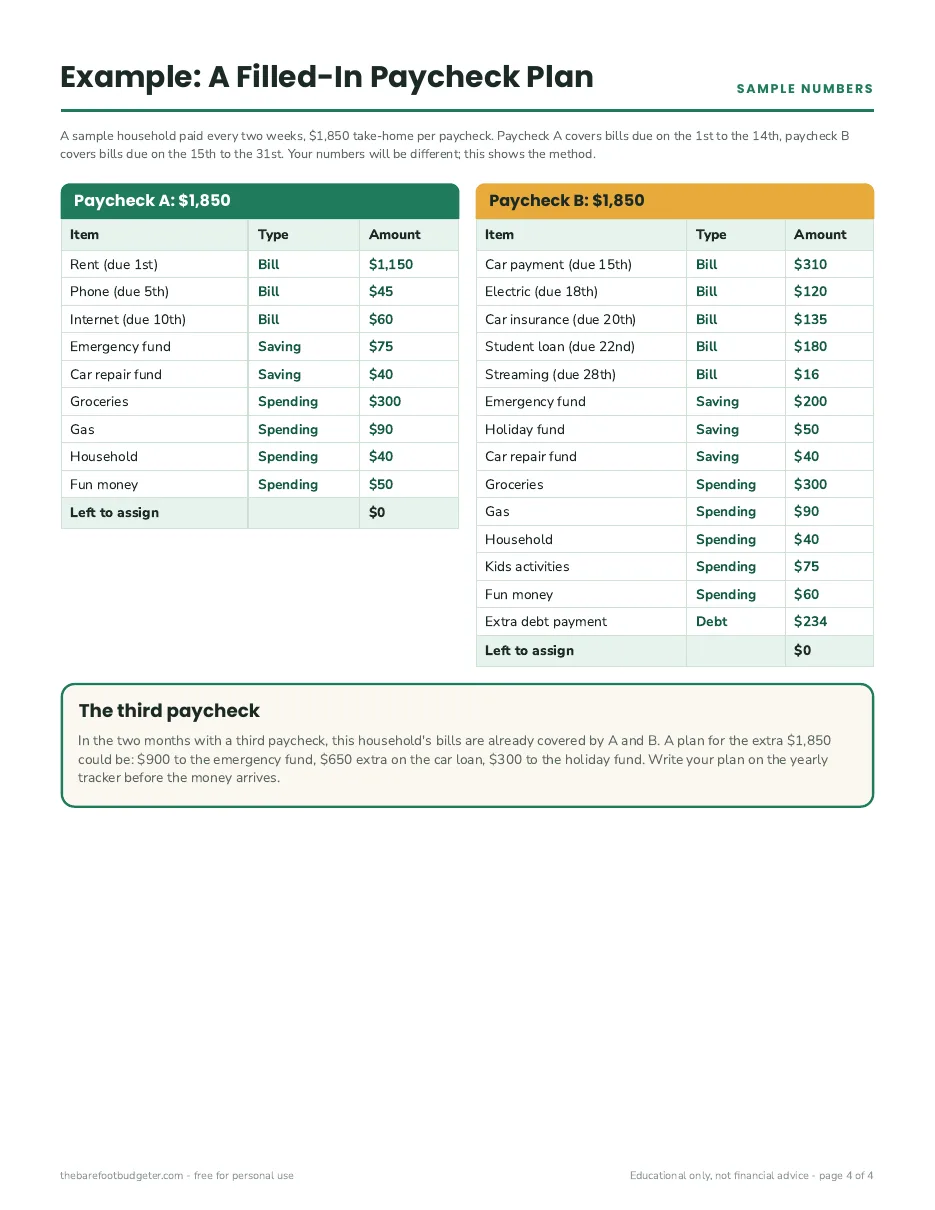
A worked example: two paychecks of $1,850
Here is a sample household paid every two weeks, with $1,850 take-home per paycheck. Paycheck A covers bills due on the 1st to the 14th; paycheck B covers bills due on the 15th to the 31st. The numbers are for illustration only.
| Paycheck A ($1,850) | Amount | Paycheck B ($1,850) | Amount |
|---|---|---|---|
| Rent (due 1st) | $1,150 | Car payment (due 15th) | $310 |
| Phone (due 5th) | $45 | Electric (due 18th) | $120 |
| Internet (due 10th) | $60 | Car insurance (due 20th) | $135 |
| Student loan (due 22nd) | $180 | ||
| Streaming (due 28th) | $16 | ||
| Bills | $1,255 | Bills | $761 |
| Emergency fund + car repair fund | $115 | Emergency, holiday and car repair funds | $290 |
| Groceries, gas, household, fun | $480 | Groceries, gas, household, kids, fun | $565 |
| Extra debt payment | $0 | Extra debt payment | $234 |
| Left to assign | $0 | Left to assign | $0 |
Notice how uneven the bills are: rent alone takes 62% of paycheck A, so paycheck A gets a smaller savings amount, and paycheck B, with lighter bills, does more of the saving and pays $234 extra toward debt. On a monthly budget both paychecks would look the same, and the squeeze at the start of the month would be easy to miss.
Paycheck calendar calculator
Enter how often you’re paid, your take-home pay and your next payday. The calculator shows your average monthly income and lists the months in the next year that bring an extra paycheck, so you can plan for them now.
Estimates only. Your employer’s payroll calendar, holidays and deductions decide your real pay dates and amounts.
What to do with a third (or fifth) paycheck
Paid every two weeks? You get 26 paychecks in most years (occasionally 27), but a plan that budgets two paychecks a month only uses 24. The two “extra” paychecks land in the months that contain three paydays. Paid weekly, you get 52 paychecks (occasionally 53), and four months have five paydays instead of four.
The simplest rule: build your regular budget on two paychecks a month (or four if weekly), so your bills never depend on the extra one. Then give each extra paycheck a job before it arrives, for example:
- Top up your emergency fund until it covers at least one month of essential bills
- Make an extra payment on your debt plan (our debt snowball worksheet shows which debt to hit first)
- Fill sinking funds for irregular costs: car registration, holidays, back-to-school
- Get one month ahead, so next month’s bills are paid from money already in the bank
Weekly, biweekly, semimonthly and monthly pay
The method is the same for every pay schedule; only the number of plans per month changes.
| Pay schedule | Paychecks per year | Paychecks per month | Budgeting tip |
|---|---|---|---|
| Weekly | 52 (sometimes 53) | 4, sometimes 5 | Plan groceries and gas weekly; assign big bills to specific weeks |
| Biweekly (every 2 weeks) | 26 (sometimes 27) | 2, sometimes 3 | Budget on 2 paychecks; plan the two 3-paycheck months ahead |
| Semimonthly (twice a month) | 24 | Always 2 | Paydays on fixed dates (often the 15th and last day); move if they fall on a weekend |
| Monthly | 12 | 1 | Split the paycheck into two halves yourself so mid-month spending is protected |
If your income is irregular (gig work, tips, commission), budget from your lowest typical month and treat anything above it like an extra paycheck.
Common mistakes and how to fix them
- Using gross pay. Always plan with take-home pay, after taxes, insurance and retirement deductions.
- Forgetting non-monthly bills. Car registration, annual subscriptions and holiday gifts need a sinking fund amount in every paycheck.
- No spending money. A plan with $0 for fun usually breaks. Give yourself a small, planned amount.
- Paying a bill from the wrong paycheck. If a bill is due the day before payday, it belongs to the previous paycheck, not the next one.
- Not adjusting. If you overspend in one paycheck, take it from the next plan instead of abandoning the budget.
Want to go further? Explore our budgeting basics guides, find more trackers in free budget printables, or see all paycheck budgeting guides.
What’s inside the free printable
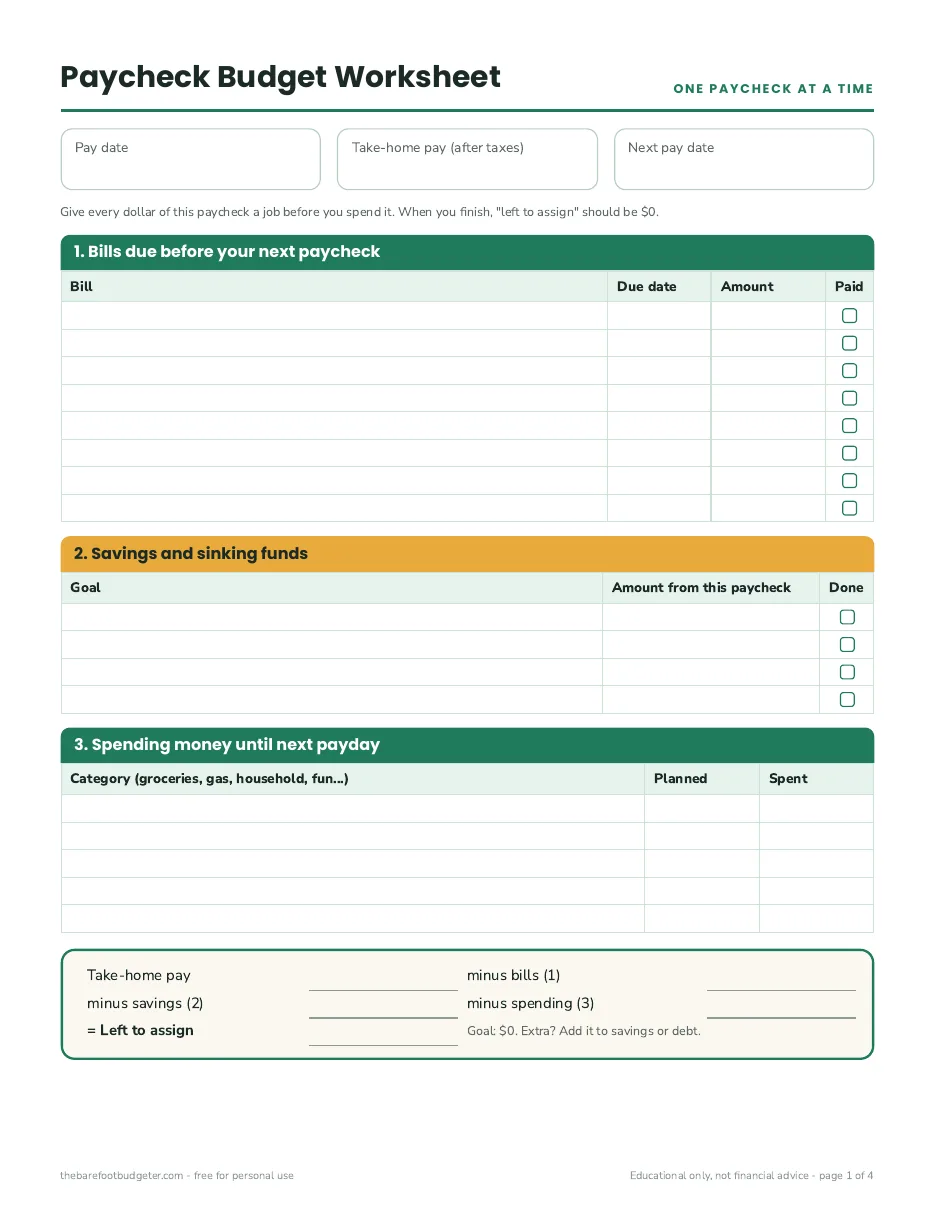
- Paycheck budget worksheet: bills, savings and spending for one paycheck, with a left-to-assign check
- Bills by paycheck planner: a monthly list with A, B and C paycheck boxes
- Yearly paycheck tracker: 27 lines so you can mark extra paychecks
- Filled-in example: the $1,850 biweekly plan from this guide
Download your free paycheck budget printable
- Paycheck worksheet, bill planner and yearly tracker
- Filled-in example to copy
- Prints in color or black and white
FAQ
How do you budget biweekly pay?
List the bills due before each payday, assign each bill to the last paycheck that arrives before its due date, then add savings and spending money until each paycheck reaches $0 left to assign. Build your normal budget on two paychecks a month and plan the two three-paycheck months separately.
What is a paycheck budget template?
It is a worksheet with space for one paycheck: your pay date and take-home pay, the bills due before the next payday, savings, planned spending and a total that should come to $0. Our free printable includes the template, a monthly bills-by-paycheck planner and a filled-in example.
Is it better to budget monthly or by paycheck?
Both plan the same money. Budgeting by paycheck adds the timing: it shows whether each paycheck can cover the bills due before the next one. If your bills are bunched together or you live close to payday, a paycheck budget is usually easier to stick to.
How many paychecks do you get in a year if paid biweekly?
Usually 26, which means two months of the year have three paychecks. Some years have 27 biweekly paydays, depending on the calendar and your employer’s schedule.
What should I do if one paycheck can’t cover its bills?
Ask the biller whether you can change the due date, set aside part of the bill from the previous paycheck, or move flexible spending like groceries to the lighter paycheck. The CFPB’s bill calendar tool is a useful free resource for planning due dates.
Is the paycheck budget printable really free?
Yes. It is a 4-page PDF in US Letter size, free for personal use, and you can download it without giving an email address.
This guide is for general education and is not financial advice. See our disclosure and how we research.